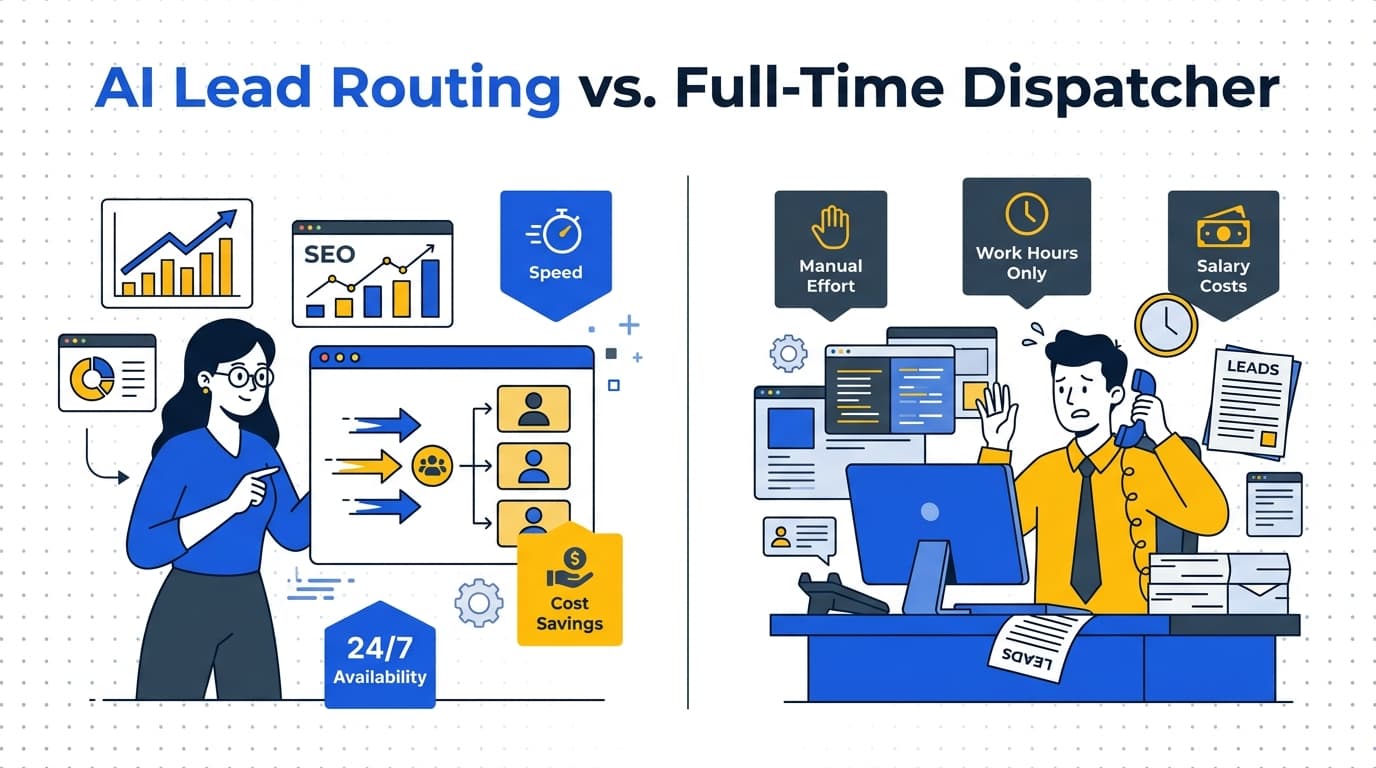
A full-time dispatcher costs a fixed salary plus benefits regardless of call volume, while AI lead routing costs a setup fee plus a monthly fee that scales with usage. The real trade-off isn't just price: a dispatcher brings judgment an AI system can't fully replicate, while AI lead routing covers every hour a single dispatcher physically can't.
Key Takeaways
- A dispatcher's real cost is salary plus payroll tax, benefits, and coverage gaps outside a single shift.
- AI lead routing scales with lead volume instead of staying fixed, and covers every hour a dispatcher can't.
- Response time, not price alone, is usually the variable that decides whether a lead actually converts.
- A good dispatcher's relationship-building and judgment on messy cases doesn't fully transfer to a routing system.
Two Different Ways To Solve The Same Problem
A dispatcher and an AI lead routing system exist to answer the same question: when a lead comes in, who should get it, how fast, and in what order. A human dispatcher does this by taking the call or reading the form submission, weighing technician availability, job type, and location, and making a judgment call. AI lead routing does the same triage automatically, using rules and, in more advanced setups, learned patterns from past outcomes, to send the lead to the right person or queue within seconds of it arriving.
Neither approach is inherently better in the abstract. The honest comparison has to be specific: what does each actually cost a home service company, and what does each actually change about how fast a lead gets a response, since response time is usually the variable that moves close rate the most.
What A Full-Time Dispatcher Actually Costs
A dispatcher's cost isn't just the base salary. It's salary plus payroll tax, benefits if offered, training time, and the ongoing cost of covering shifts when that person is sick, on vacation, or leaves the role and needs replacing. That total is meaningfully higher than the number on the offer letter, and it's a fixed cost that exists whether five leads come in that day or fifty.
The part that's easy to undercount is coverage. A single dispatcher covers roughly one shift. Leads that arrive nights, weekends, or during a lunch break either wait or go to voicemail unless a business is paying for overlapping shifts or an answering service on top of the dispatcher's regular hours.
The Real Cost Comparison
Any real cost comparison has to include the coverage gap, not just the base salary, because it's often where the actual lost opportunity is.
What AI Lead Routing Actually Costs
AI lead routing typically involves a setup cost to configure the rules (which tech handles which service area, which job types need which skill level, how leads should be prioritized) plus an ongoing monthly cost that scales with lead volume rather than staying fixed. For a business with the same lead volume a single dispatcher was already handling, the monthly cost is often well below dispatcher-level compensation, though the exact figure depends entirely on lead volume and how much custom logic the routing needs.
There's also a maintenance cost worth naming honestly: routing rules drift out of date as a business adds technicians, changes service areas, or starts offering a new job type, and someone has to update the logic when that happens. It's a smaller, occasional cost compared to a dispatcher's ongoing salary, but treating a routing system as a one-time setup with zero upkeep afterward is the kind of overclaim that leads to a system quietly misrouting leads six months later.
Not sure what your own lead volume actually needs?
We'll map your current lead volume and routing logic before quoting anything.
Why Response Time Is The Real Lever
The reason this comparison matters isn't dispatcher salary versus software subscription in the abstract, it's that response time has a direct, well-documented relationship with whether a lead converts at all. A lead that sits for even a few hours, let alone overnight, has usually already called a competitor. A dispatcher working a normal shift can respond quickly during that shift and not at all outside it. AI lead routing responds at the same speed regardless of time of day, which is precisely the gap a single dispatcher structurally can't close without a second shift or an answering service layered on top.
It's worth being specific about what “faster response” actually means in practice: the lead is routed to the right technician's queue or given an immediate automated acknowledgment within seconds of arriving, not that a human necessarily calls back at 2am. For most home service businesses, that near-instant acknowledgment plus a same-morning human follow-up beats a next-business-day response by a wide enough margin to matter.
Where A Human Dispatcher Still Wins
This needs to be said plainly, because it's easy for automation content to gloss over it: a good dispatcher builds relationships, both with repeat customers and with the field technicians they're coordinating, and that judgment doesn't fully transfer to a routing system. A dispatcher who knows a specific technician is great with nervous first-time customers, or that a certain customer always needs extra reassurance on the phone, is making calls a rules-based system won't make the same way.
Dispatchers also handle the genuinely messy cases well: a customer who's upset, a job that doesn't fit any standard category, a scheduling conflict that needs real negotiation between two customers. Businesses with a lot of these edge cases, or ones where the relationship itself is a big part of the sale, get less relative benefit from automating routing than businesses with high call volume and fairly standardized jobs.
The Bottom Line
A dispatcher and AI lead routing solve the same problem differently. AI usually earns its cost fastest by covering the hours a single dispatcher physically can't, while a good dispatcher still wins on judgment, relationships, and the genuinely messy cases. Most home service companies end up running both: AI catching and triaging everything the moment it arrives, with a human dispatcher still handling the judgment calls and the accounts that need one.
Frequently Asked Questions
In most cases the ongoing monthly cost is lower than a dispatcher's full compensation (salary, payroll tax, and benefits), but the comparison depends on your specific lead volume and routing complexity. The fairer comparison also accounts for coverage: a dispatcher covers roughly one shift, while AI lead routing covers all hours without an added coverage cost.
Not for every business. AI lead routing handles fast, consistent triage well, especially outside business hours, but a dispatcher's relationship-building and judgment on messy, nonstandard cases doesn't fully transfer to a routing system. Many home service companies run both together rather than replacing one with the other entirely.
AI lead routing typically responds within seconds regardless of time of day, while a dispatcher's response time depends on whether they're on shift and available when the lead arrives. The biggest gap shows up outside normal business hours, when a single dispatcher structurally can't be covering the phone.
Yes, a lead that sits unanswered for hours has often already contacted a competitor by the time anyone follows up. This is one of the clearest, most measurable reasons response time gets treated as a priority in lead routing decisions, rather than a nice-to-have.
Setup cost depends on how many service areas, job types, and technicians the routing logic needs to account for, so there's no single flat number that applies to every business. The right way to evaluate it is mapping your current lead volume and routing logic first, then comparing that scoped cost against dispatcher-level compensation.
Businesses where the sale depends heavily on relationship and judgment, highly custom jobs, a lot of edge cases, or customers who need real reassurance on the phone, get less relative benefit from automating routing than businesses with high call volume and fairly standardized jobs.
Yes, and it's a common setup: AI lead routing catches and triages every lead immediately, especially outside business hours, while a human dispatcher still handles judgment calls, relationship-heavy accounts, and anything flagged as an exception. This combines coverage with judgment rather than trading one for the other.