A plumber who misses one call while under a sink does not just lose that job, the homeowner can dial the next number on the list, and whether that caller reaches a human answering service, an AI receptionist, or your voicemail decides which company gets the work. Every trades business has the same gap: the phone rings while someone is on a roof or between stops. How you fill that gap, not whether you fill it, is the real decision.
Key Takeaways
- A missed call at a trades business can send the caller to the next company, so the choice is between a human answering service, an AI receptionist, or an in-house office hire.
- A human answering service takes a message and passes it along, while an AI receptionist can collect the job details and book straight into your calendar without waiting for anyone to read a note.
- Consistency is where the two split furthest apart: a human team varies call to call, while an AI receptionist asks the same qualifying questions on every call, including after hours.
- An in-house office person still beats both options for complex quotes, upset customers, and judgment calls that do not fit a script.
- Platinum Web Studio's AI phone answering answers in your company's name, collects the job and address, books into your calendar or CRM, and texts you a summary, in English and Spanish.
What Happens to a Missed Call at a Trades Business
Picture a Tuesday afternoon. Your crew is mid-job, your phone is in your pocket, and a homeowner with a leaking water heater is calling down a list of five companies. A caller who reaches voicemail simply calls the next company. One answered by someone who skips the right questions ends up in a stack of sticky notes until someone follows up, if anyone does.
The three ways to close that gap are a human answering service, an AI receptionist, or hiring someone in-house. Each decides whether the job lands on your calendar instead of a scrap of paper. None is free of tradeoffs: a person, outsourced or in-house, brings judgment a script cannot replicate, and a script, run by AI, brings consistency a rotating group of people cannot promise.
How a Human Answering Service Handles Contractor Calls
A human answering service is a team of live agents, usually shared across many client businesses, who pick up your line when you cannot. The agent follows a script you provide: greet the caller, ask what they need, and take a message or transfer the call. Some book appointments; many are built for message taking only.
The strength here is real human judgment. An agent can hear that a caller is upset, slow down, and handle an odd request by improvising.
The weak points show up in volume and consistency. The agent answering at 7 a.m. may not be the one who answered at 9 p.m. Because the service covers many businesses, the agent works from your notes rather than deep familiarity with your area, so messages tend to be accurate but thin: a name, a number, and a general description, rather than the address, the exact issue, and a booked time.
How an AI Receptionist Handles Contractor Calls
An AI receptionist answers your business line and runs a script built around your services, written once and used identically every time. Platinum Web Studio's AI automation and phone answering serviceanswers in your company's name and works from the service list, pricing rules, and service area you provide.
Because the script does not vary, an HVAC call, a plumbing call, and an electrical call each get the questions that matter: leaks and shutoff valves for plumbing, system type for HVAC, a burning smell for electrical. The caller answers the same way they would with office staff, without waiting for someone to be free.
What lands on your end differs from a message service. Instead of a note waiting to be read, the call books directly into your calendar or CRM when it fits your rules, and you get a text summary with the caller's details. Platinum Web Studio's own AI automation and phone answering service page also lists an automatic text back when a call goes unanswered and a Google review request once a job is marked complete, so both events get a follow-up without anyone remembering to send one. That routing runs through our CRM and lead management service, so a booked job has a source and a next step.
Language is another point where an AI receptionist extends past a single shift. Platinum Web Studio configures its AI phone answering for English and Spanish, so a caller more comfortable in Spanish is not stuck hoping the person who answers understands them.
The honest limit is judgment. Platinum Web Studio's service page names this limit directly: a call that turns into something like a warranty dispute or an unusual job gets handed off to a person instead of an automated guess, which is why an escalation path to a human still matters.
AI Receptionist vs Answering Service: Side by Side
| What matters on the call | Human Answering Service | AI Receptionist |
|---|---|---|
| Booking into your calendar | Depends on the service, often a message instead | Books directly into your calendar or CRM when the job fits your rules |
| Collecting job and address details | Varies by agent and shift | Same qualifying questions every call, written around your trade |
| Consistency across shifts | Different agents interpret your script differently | Identical script on every call, after hours included |
| Languages | Depends on which agents are staffed | Configured in advance; Platinum Web Studio supports English and Spanish |
| Upset or complex callers | Strongest option; live judgment in the moment | Weakest point; needs a clear handoff to a person |
| What you see afterward | A message, sometimes a booked slot | A text summary and, when applicable, a booked appointment |
The pattern across every row is the same trade: judgment that varies call to call versus consistency with no judgment for the hard cases. Neither is universally better, each covers a different part of the problem.
When an In-House Office Person Is the Right Call
Some trades businesses are better served by hiring someone to answer, quote, and dispatch directly. An in-house hire knows your crew's schedules, regular customers, and the judgment calls that come up often enough to matter.
This option makes sense once call volume and job complexity reach a point where a dedicated person earns their keep: custom quotes, high-ticket jobs, or repeat commercial accounts that expect a familiar voice. It also closes the fewest judgment gaps, since one person handles each call start to finish.
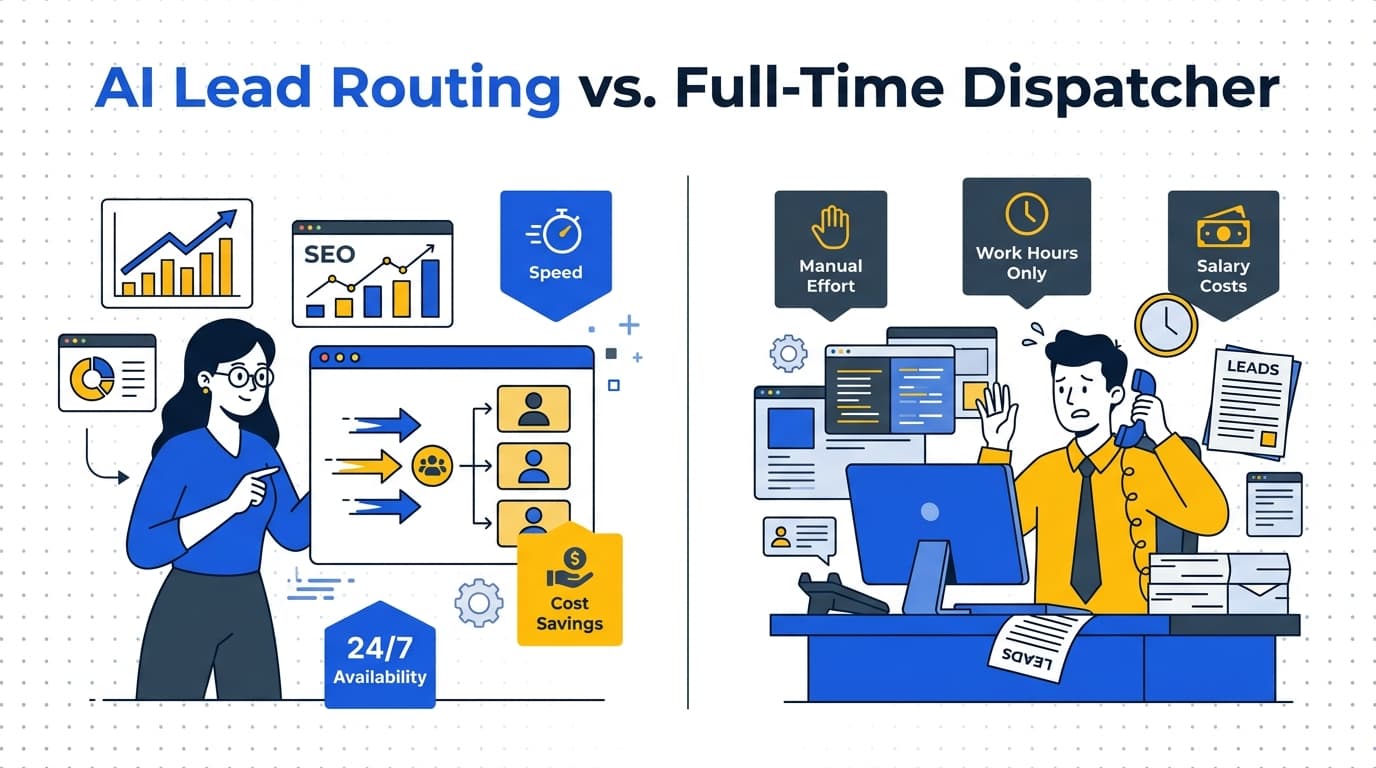
The tradeoff is coverage. One person cannot answer every call at every hour, and vacations and sick days create gaps. Many businesses combine an in-house hire with automation: a person for relationship calls, an AI receptionist or answering service for the rest. For the cost side of automating the routing work a dispatcher normally does, see our comparison of AI lead routing versus a dispatcher's cost, which draws on Bureau of Labor Statistics wage data for the Los Angeles area.
How to Choose for Your Trade
Start with where your calls come from. A roofing or HVAC company fielding emergency calls at odd hours has a different problem than a remodeling company fielding a few detailed quote requests a week. The busier and more repetitive your call pattern, the more an AI receptionist's consistency pays off. The more your jobs depend on a real conversation to close, the more a person, in-house or through an answering service, earns the cost.
One more check belongs on that list: ask whether the service records calls, and if your business is in California, whether it gets the caller's consent first. California Penal Code 632 makes recording a confidential call without the consent of all parties a crime, punishable by a fine of up to $2,500 for a first offense, so a provider handling your calls needs a clear answer for how.
Trade also shapes the script. Our local AI phone answering page for Sherman Oaks contractors shows how the system gets tuned to a service area, down to gate codes or whether a caller is a tenant.
Most trades businesses that get this right combine options rather than pick one and stop: an AI receptionist or answering service for the coverage gap, a person for the calls that need real judgment.
If you want to hear the difference before deciding, Platinum Web Studio offers a free 15-minute audit with a live demo built on your own services.
Book your free audit and hear how your callers would be greeted, qualified, and booked.
Frequently asked questions
Pricing varies enough between answering services and AI receptionist providers that there is no single number to quote here, and Platinum Web Studio gives its own monthly figure on a free 15-minute call after a live demo.
An AI receptionist built for booking, like Platinum Web Studio's AI phone answering, asks for the job and address and books directly into your calendar or CRM when the request fits your rules, instead of only recording a message. You set which job types book automatically and which need your review first.
Some AI receptionist systems identify themselves as automated, and how a caller experiences the interaction depends on the script and voice quality the provider builds. Focus instead on whether the caller's questions get answered and the job gets booked correctly.
A well-built AI receptionist script can flag emergency language, such as a burning smell or an active leak, and route that call differently than a routine request. You decide in advance whether emergencies route to your cell phone, trigger a priority text, or book the next available slot.
When a caller's question falls outside the script, such as a warranty dispute, a properly configured AI receptionist takes their details, tells them a person will follow up, and notifies your team instead of guessing. A person still needs to be reachable behind any automated system.
A human answering service can be a reasonable fit for a business with low call volume, because judgment-based handling costs less to justify with only a handful of calls each week. Once volume grows, the consistency gap between shifts grows more noticeable.
Platinum Web Studio configures its AI phone answering for English and Spanish, so a caller more comfortable describing their job in Spanish can do so instead of struggling through the call. Ask any provider which languages their system actually supports before assuming coverage matches your callers.
Both an AI receptionist and a human answering service take the first-response and scheduling load off your office staff, not the people who quote jobs, dispatch crews, and handle upset customers. Your team still starts each day working from booked appointments instead of a voicemail box.