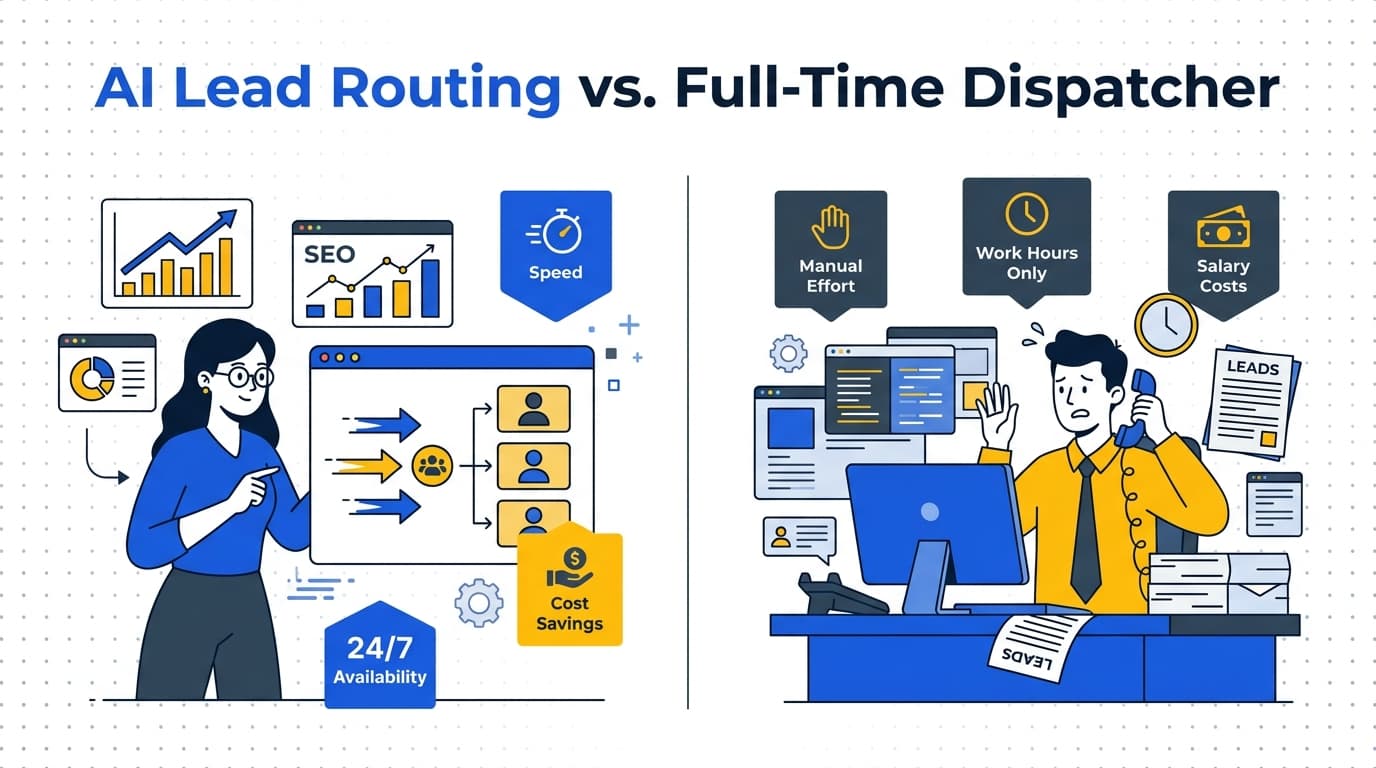
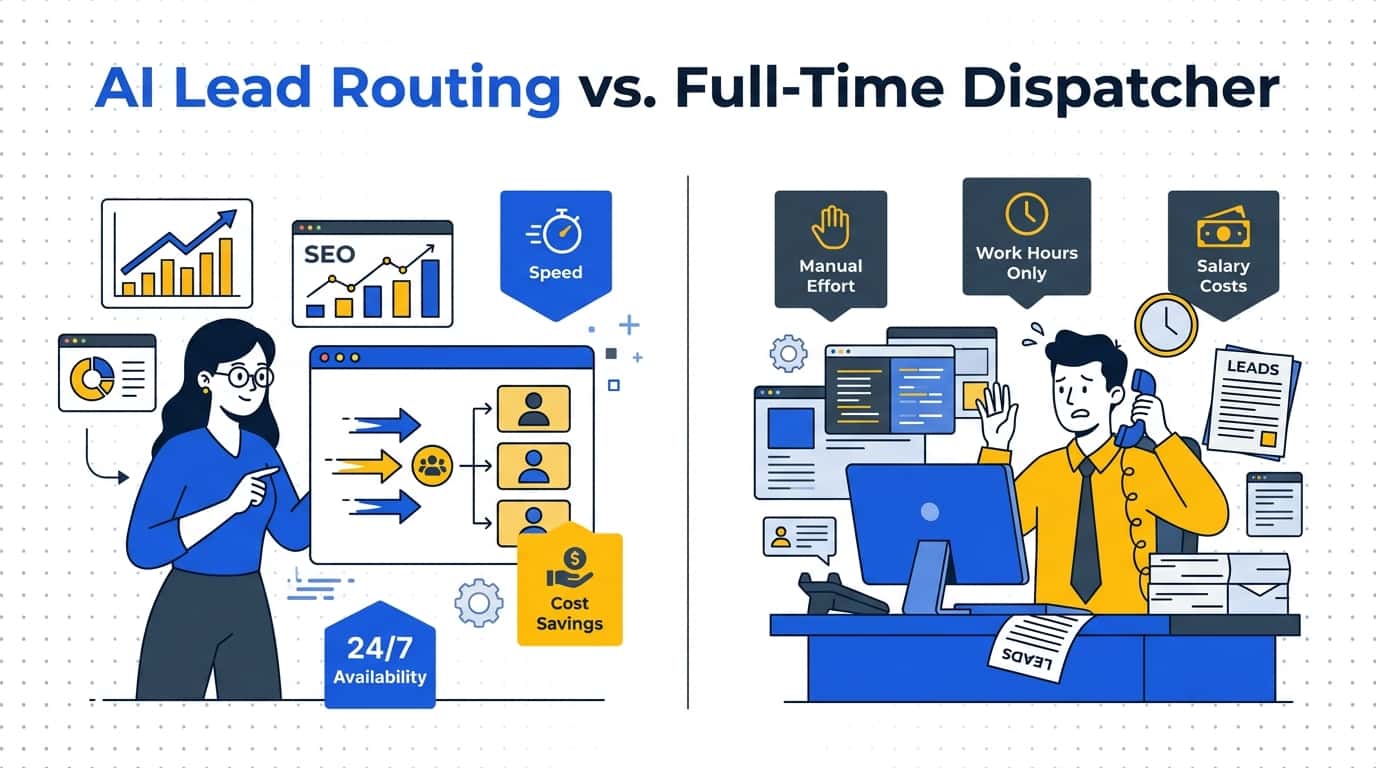
A dispatcher in the Los Angeles metro area earned a median $52,170 a year in May 2025, according to the Bureau of Labor Statistics. With benefits at the BLS private-industry share of 30.0 percent, that is roughly $74,500 a year, and it buys one full-time shift: 40 of the 168 hours in a week. AI call routing has no salary line. You pay a one-time setup, a monthly platform fee, and rule upkeep, and the AI decisions on each inquiry are the smallest line item. What routing replaces is the sorting part of the job: reading each new inquiry, tagging its service and urgency, assigning a technician, and texting the customer, at 2 a.m. the same as at 10 a.m. What it does not replace is judgment on upset customers, unusual jobs, and scheduling conflicts. For most home service companies routing is the smaller bill, and a person is still worth paying for the exceptions.
Key Takeaways
- The Bureau of Labor Statistics put the May 2025 median wage for non-emergency dispatchers at $52,170 in the Los Angeles metro area and $50,340 nationally.
- Benefits made up 30.0 percent of private-industry employer compensation costs in June 2026, per the BLS, so a dispatcher's true cost runs well above the salary.
- A single 40-hour dispatcher shift covers about 24 percent of the 168 hours in a week, while AI call routing handles every inquiry at any hour.
- AI call routing costs setup, a monthly platform fee, and rule maintenance; the AI decisions themselves are the smallest line item.
- A human dispatcher still wins on upset customers, nonstandard jobs, and scheduling conflicts, which is why many home service companies run both.
What Does a Full-Time Dispatcher Cost in Los Angeles?
The Bureau of Labor Statistics tracks this job as Dispatchers, Except Police, Fire, and Ambulance, the occupation that covers dispatchers at service companies. Its May 2025 Occupational Employment and Wage Statistics put the median annual wage at $50,340 nationally, $52,350 in California, and $52,170 in the Los Angeles-Long Beach-Anaheim metro area, where about 7,700 people held the job. The LA metro mean was higher, at $57,530.
The wage is only part of the cost. In the BLS Employer Costs for Employee Compensation release for June 2026, wages made up 70.0 percent of private-industry employer costs and benefits the remaining 30.0 percent. If a dispatcher earning the LA median came with benefits at that national share, the employer's total cost would be roughly $74,500 a year. That figure is simple arithmetic on BLS averages, not a quote; your own payroll will differ.
$52,170
LA metro median dispatcher wage, BLS May 2025
30.0%
benefits share of private-industry pay costs, BLS June 2026
40 of 168
weekly hours one full-time shift covers
Costs that never show up on the offer letter
California adds its own line items. The Department of Industrial Relations requires time and a half for hours over 8 in a workday or over 40 in a workweek, and double time past 12 hours in a day. A dispatcher who stays late through a heat-wave rush is paid overtime. Then add payroll taxes, paid sick days, the weeks spent training a replacement when the person leaves, and the hours nobody covers during lunch, vacation, and illness.
What Does AI Call Routing Cost?
There is no single price for AI call routing, because it is built for your business rather than bought off a shelf. The cost has four parts:
- Setup. Mapping every place an inquiry arrives (web forms, calls, texts, ad form submissions) and writing the rules: which technician covers which ZIP codes, which job types need which skills, and what counts as urgent.
- Platform. A monthly CRM or automation subscription that stores the inquiries and runs the rules.
- Decisions. The AI calls that classify each inquiry. This is the smallest line: TypeSafe, for example, lists its Jev decision model at $0.042 per million input tokens, and a contact form is a short piece of text.
- Maintenance. Rules drift out of date when you add a technician, change service areas, or start a new job type, and someone has to update them.
Most of the work lives in setup and upkeep. That is why our CRM and customer follow-up service starts by mapping your inquiry sources before anything else: a centralized inquiry inbox, automatic tagging by source, service, and priority, follow-up reminders, and reporting on inquiry volume, response time, and conversion rate.
The bigger difference from a salary is the shape of the cost. A dispatcher costs the same whether 5 or 50 inquiries arrive that day. Routing cost moves with volume, and it never needs a second shift to cover nights.
Coverage and Response Time: Where the Real Cost Gap Sits
The 168-hour week is where the comparison stops being close. One full-time dispatcher covers 40 of those hours, about 24 percent. Covering evenings and weekends means a second hire, an answering service, or inquiries waiting until morning. Service calls do not keep office hours: a water heater fails on a Sunday, and an AC quits on a hot evening.
A 2011 Harvard Business Review study by Oldroyd, McElheran, and Elkington studied how quickly companies respond to inquiries that customers submit online, and why speed matters. A homeowner who submits a form at 9 p.m. and hears nothing has all night to call someone else.
An answering service narrows the gap but does not close it. It takes a message, yet the message still waits for a person to read it, decide who should take the job, and call back. Routing does that middle step on its own: by the time anyone opens the CRM, each overnight inquiry already has a service type, an urgency level, and an assigned technician.
What fast actually means
AI call routing does not promise that a technician calls back at 2 a.m. It means the inquiry is logged, classified, assigned, and acknowledged by text within moments, and the right person sees it first thing in the morning, already sorted.
How AI Call Routing Decides Where an Inquiry Goes
A routing system runs the same five steps for every inquiry, whether it arrives from a form, a missed call, or a text:
Step 1
Capture
Form fields, call transcripts, and texts land in one inbox instead of three apps.
Step 2
Classify
A decision model answers typed questions: which service, how urgent, and whether it is a real request or a vendor pitch.
Step 3
Assign
Rules match the request to a technician or queue by service area, skill, and calendar.
Step 4
Acknowledge
The customer gets a text confirming the request and what happens next.
Step 5
Escalate
Anything the model is unsure about, or anything flagged as upset or unusual, goes to a person.
Step 1 is where most routing setups fail. A form that asks only for a name and a message leaves the classifier guessing. A form that asks for service type, ZIP code, and urgency gives it facts. That is why routing work often starts with the forms on your site, the kind of change our web design and development team builds into every contact page.
Where a Human Dispatcher Still Wins
A good dispatcher builds relationships with repeat customers and with the technicians in the field. A dispatcher who knows one tech is great with nervous first-time customers, or that a certain customer always needs extra reassurance, makes calls a rules-based system will not make the same way.
Dispatchers also handle the messy cases: an upset customer, a job that fits no standard category, a scheduling conflict that needs real negotiation between two households. A routing system handles these by passing them on, not by solving them. The better the escalation rule, the more of the dispatcher's day goes to exactly these calls.
AI Call Routing vs a Dispatcher: Which Fits Your Business?
- Many inquiries arrive after hours or on weekends. AI call routing closes the gap a single shift cannot.
- High volume of standard jobs. Tune-ups, drain clears, and repairs sort well by rule; a dispatcher, if you have one, handles the exceptions.
- Low volume, high-ticket custom work. A person on the phone often earns the sale. Automate the acknowledgment and the logging, not the decision.
- You already have a dispatcher. Add routing behind that person so nights and weekends are covered and each morning starts with a sorted queue.
Most home service companies end up with the hybrid: software on every inquiry, a person on every exception.
See what routing would take for your call volume
Send us your inquiry sources and a rough monthly count. We will map your current inquiry volume and routing logic before quoting anything.
The Bottom Line
By BLS numbers, a Los Angeles dispatcher costs a five-figure salary plus benefits (30.0 percent of private-industry pay costs in June 2026) and covers about a quarter of the week. AI call routing covers the other three quarters for a setup cost, a platform fee, and upkeep. Keep the person for judgment and let the software carry the queue.
AI Call Routing vs Dispatcher FAQ
The Bureau of Labor Statistics put the May 2025 median wage for dispatchers in the Los Angeles-Long Beach-Anaheim metro area at $52,170 a year, before benefits, payroll taxes, overtime, and the cost of covering sick days and vacations. With benefits at the June 2026 national private-industry share of 30.0 percent, total cost lands near $74,500.
For most home service companies the ongoing cost of AI call routing is lower than a dispatcher's full compensation, but the honest comparison depends on inquiry volume, service areas, technician count, and how much custom logic the rules need. Coverage matters as much as price.
AI call routing can replace the sorting, assigning, and after-hours acknowledgment a dispatcher does, but it cannot replace the judgment a good dispatcher brings to upset customers, unusual jobs, and scheduling conflicts. Many companies keep the person and automate the queue.
AI call routing logs, classifies, and acknowledges a new inquiry within moments of it arriving, at any hour, while a dispatcher's response depends on whether that person is on shift and free when the call or form comes in. The biggest difference shows up on nights and weekends.
Setup cost depends on how many inquiry sources, service areas, job types, and technicians the routing rules must account for, so there is no single flat price that applies to every home service business. We map your sources and rules first, then quote the scoped build.
You usually need a better form rather than a new website, because routing works best when the form asks for service type, ZIP code, and urgency instead of only a name and an open message box. Better inputs mean fewer requests sent to the wrong technician.
Businesses with low inquiry volume, highly custom jobs, and sales that depend on a long phone conversation get the least from automated routing, because a person handles each inquiry anyway and the setup cost is spread over very few inquiries. Automate acknowledgment and logging there instead.