When the freelancer who built your plumbing company's website stops returning texts, you find out fast whether you actually own your domain, hosting account, or contact form. That moment, not the price on the invoice, is what separates a web design agency vs freelancer vs DIY decision from a coin flip. Each option fits a different business at a different stage.
Key Takeaways
- The real cost difference between DIY, a freelancer, and an agency is not the price tag. It is who writes the copy, takes the photos, and manages Google Business Profile and call tracking after launch.
- Domain and code ownership should be settled before any money changes hands, because a site built under someone else's account can become unreachable if that person disappears.
- Website builders like Wix price their own plans; as of this writing, Wix's pricing page lists Light at $17 a month, Core at $29, Business at $39 and Business Elite at $159, for yearly plans paid up front, before tax.
- DIY makes sense for a one-person operation testing an idea. A freelancer fits a business with in-house marketing help. An agency fits a company that wants Google Business Profile, tracking, and ongoing fixes handled without hiring a specialist internally.
- A side by side comparison only means something once you know which of these five things matters most to your business: time, ownership, copy and photos, ongoing maintenance, or risk if the vendor vanishes.
Three ways to get a contractor website
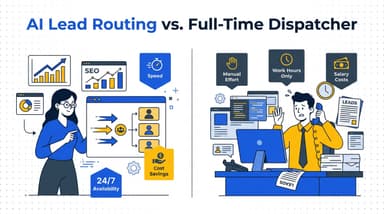
Every contractor site gets built one of three ways: you build it yourself on a website builder, you hire a freelance designer, or you hire an agency. Each path handles the same jobs differently: writing the copy, sourcing photos, setting up Google Business Profile, installing call tracking, and fixing problems after launch.
The decision is not really "which option is cheapest." It is "who is doing each of those jobs, and what happens when something breaks in six months." A roofing company owner comparing a website builder vs web designer often assumes the builder is the safe default. That is only true if you value your own time at zero and are comfortable fixing the site yourself.
Building it yourself
A DIY build means you pick a platform, usually a drag-and-drop builder, and do the writing, photo selection, and setup work yourself. You own the account and domain from day one, which is the strongest argument for this route. Nobody else holds the login, though the site itself stays tied to that builder's platform rather than moving with you.
The tradeoff is time and the parts of the job that are easy to skip. Google Business Profile setup, structured contact forms, call tracking, and on-page SEO are all things a builder makes technically possible but does not do for you. If you have never set up conversion tracking in Google Analytics, that gap usually shows up first: the site looks fine, but nobody can tell you where a lead came from. Our website analysis service exists for exactly that gap, checking whether a site actually tracks and converts visitors.
Pricing on builders is public and changes often, so check the platform's own page before you commit. As of this writing, Wix's pricing page lists Light at $17 a month, Core at $29, Business at $39 and Business Elite at $159, for yearly plans paid up front, before tax. Those numbers are Wix's, not ours, and they will shift, so verify them directly before budgeting.
DIY suits a solo operator testing whether a website is worth the effort, or a business where staff already have time to maintain it.
Hiring a freelance web designer
A freelancer is one person, usually working on multiple clients at once, who builds the site to your spec. The upside is real: freelancers are often more flexible on scope and less expensive than an agency, especially for a straightforward brochure site.
The risk sits in exactly the place the opening of this article pointed to. If a freelancer built your site under their own hosting account or domain registrar login, and they stop answering, you may not be able to update a phone number, let alone fix something that broke. Before you hire a freelancer, ask directly: whose name is on the domain, whose account hosts the site, and do you get admin access to both from day one. A vague answer is the answer.
Freelancers also vary in whether Google Business Profile and analytics setup are part of the build or a separate add-on. Get that in writing before the project starts, not after the invoice.
A freelancer fits a business that already handles its own marketing and photography and just needs the site built. It is weaker if you want one vendor accountable for the whole picture.
Hiring a web design agency
An agency is a team, which means the work is split across people who each specialize in one piece: design, copywriting, SEO, and technical setup. The main advantage is coverage. Instead of chasing down whether Google Business Profile, call tracking, and SEO all got handled, one contract typically covers it, and the agency does not disappear if one employee leaves.
Our Growth website package is one concrete example of what a trades-focused agency engagement can include. It is a $1,499 one-time project covering up to 3 pages, custom design, mobile-responsive layout, on-page SEO, 10 or more unique image assets, Google Business Profile optimization, a contact form with click-to-call, Google Analytics and call tracking setup, 2 rounds of QA testing, and 15 days of post-launch support. That list matters more than the price: it shows what "an agency handles it" means in practice, task by task.
An agency also tends to be the better fit when you want the site connected to the rest of your marketing, not just a standalone brochure. If you also run ads, local SEO, or lead tracking, having one team handle the technical side removes a layer of finger-pointing when something does not track correctly. You can see the kind of finished work an agency produces through a portfolio before committing to anything.
An agency fits a business that wants copy, photos, Google Business Profile setup, and tracking handled by one accountable team.
Side by side comparison
| DIY builder | Freelancer | Agency | |
|---|---|---|---|
| Who writes the copy | You | Sometimes included, ask first | Usually included |
| Who takes or sources photos | You | Sometimes included, ask first | Usually included |
| Google Business Profile setup | You, if you do it at all | Varies, confirm in writing | Usually included |
| Call tracking and analytics setup | You | Varies, confirm in writing | Usually included |
| Who owns the domain and code | You own the account and domain; the site itself stays on the builder | Depends on the contract | Depends on the contract, confirm |
| Who fixes it after launch | You | Depends on availability | Defined support window |
| Risk if the vendor disappears | Low, you hold the accounts | Higher, confirm access first | Lower, team-based |
Read this table alongside the sections above it. "Who owns the domain and code" is not a formality. It is the difference between updating your own phone number in minutes and being locked out of your own site while you sort out account access with a registrar's support line.
How to decide for your business
Start with one question: who is going to write the copy and gather the photos if not the vendor? If the answer is "nobody," DIY is a poor fit no matter how cheap the builder is, because an empty template with stock photos will not do the job of an actual website.
Next, ask what happens to Google Business Profile and call tracking. If those need someone experienced to set them up correctly the first time, that pushes you toward a freelancer who includes it or an agency where it is standard.
If you want a clear answer on which of these three paths fits your business, request a free 15-minute audit and we will walk through what your site needs before you spend anything.
Then settle ownership before you settle price. Ask any freelancer or agency, in writing, whose name goes on the domain and who holds admin access to hosting. This question alone prevents the worst outcome here: paying for a website you cannot control. Page speed matters too, and our earlier piece on why slow load times cost you customers is worth reading before you finalize a route.
Finally, weigh your own time honestly. A DIY build that eats your evenings for weeks is not free, it costs the hours you were not running your business. Compare that real cost against a freelancer's quote or an agency package like our web design and development service before deciding.
Frequently asked questions
A website builder can work for a solo operator testing an idea, as long as you are willing to write the copy, source the photos, and set up Google Business Profile and tracking yourself. It weakens once you no longer have spare time to maintain the site.
You need a web designer once the jobs a builder leaves to you, like copywriting, photography, Google Business Profile setup, and call tracking, are things you do not have time to do correctly yourself. A builder like Wix suits someone willing to handle every one of those tasks personally.
A freelancer is one person handling your project alongside other clients, while an agency is a team where design, copy, SEO, and technical setup are split across specialists who do not disappear if one person becomes unavailable. Accountability and coverage are the real differences.
Ownership depends on whose name is on the domain registration and hosting account, a detail you should confirm in writing before the project starts, not after. Registering under the freelancer's own account risks lost access if they become unreachable.
Costs vary by scope and vendor, so this article avoids naming freelancer or agency price averages since those figures are not something we can verify or stand behind. As one concrete example, our own Growth website package is $1,499 one-time for up to 3 pages with design, SEO, and tracking included.
What happens depends on who holds the domain and hosting accounts, which is why confirming access in writing before you start is the most protective step here. Holding the accounts yourself means you can hire someone new to take over.
Yes, because Google Business Profile is often how a local customer finds a contractor, and a site with no matching, optimized profile misses local search traffic. Confirm whether your builder, freelancer, or agency includes this setup before assuming it is handled.
Yes, switching later is common and usually straightforward as long as you control your own domain registration, since that is what lets a new vendor take over without a gap in your online presence. A builder site like Wix cannot be exported, so a new vendor usually rebuilds it; keeping your domain is what keeps the switch smooth.